ENSU 1000: Leadership in Environmental Sustainability

Emerson Goodall

Thompson Rivers University

On the home page of this webpage you will find a brief introduction, photo evidence pertaining to categories A, C, D, E, F, as well as reflective paragraphs that outline my experiences and the growth I have had throughout my time at Thompson Rivers University. At the bottom of the home page you will also find my giveback project and its link. Using the buttons below you may navigate to two other pages the “Verification Forms” button will direct you to all of my verification forms for each category, and the “Reflective Essay” button will direct you to my reflective essay.

Home

Introduction:

I am Emerson Goodall, a student at Thompson Rivers University. Throughout my time in the Geography and Environmental Studies Major and Environmental Economics Minor, I have learned a plethora of knowledge pertaining to sustainable practices, climate change, and how to engage with and inspire others. I love our planet and I hope to use the education I have obtained at TRU to continue my studies and enter into the field of Environmental Economic Management. I believe I can, and will, aid in mitigating the climate crisis, as the famous Economist Tyler Cowan says “Our top moral priority should be preserving and improving humanity’s long-term future. The way to do that is to maximize the rate of sustainable economic growth.”

Category A – Courses: 1000, 2020, 3700, 3120, and 4800

The courses listed above are only five of the many different Geography courses I have taken at TRU, all taken within the time from my first to last year at Thompson Rivers University. These courses all aided in deepening my understanding of the natural world and how human actives impact it.

GEOG 1000: is a course that analyzes glaciers and assesses their likelihood of survival. This course introduced me to the detrimental effects climate change has on glaciers in Canada. It is a concise overview of how glaciers and river systems function and how human actions influence them. In this class I was also taught how to create my first academic poster. The understanding of Earth systems that I gained from this class informed me about just how fragile these systems are, and how humans unsustainable building and pollution practices can destroy these fragile systems. This class did not provide me with a lot of knowledge about how to mitigate or adapt to these changes but it gave me a great understanding surrounding the importance of creating mitigation and adaption strategies to protect these Earth systems.

GEOG 2020: is a course that analyzes natural processes like wind, ocean currents, and temperatures, and how they can influence large land bodies and storm surges. This course built on my understanding of how individual systems operate and are influenced, as well as how each of these systems are interconnected and how when one system is negatively impacted it can have a chain effect. This course did not specifically focus upon climate change but did discuss how warming weather can increase storm severity and floods. This information is another indicator towards the important of clean energy and sustainable devilment in commuting the warming climate and reducing humans overall influence on these systems through our cumulative pollution.

GEOG 3700: is a course that was delivered as a field school in Well Grey provincial park. This field school introduced me to the type of daily procedures geographers may go through to analyze different landscapes including hydrologists, physical geographers, and economic geographers. The economic geography part really stuck out to me as it highlighted how important city planning is as well as “doing it right the first time.” This can be seen as branching directly into how important sustainable development is. To prevent additional emissions in the future we as a society must continue transition the construction of new residential and industrial building into green-energy functioning buildings.

GEOG 3120: is a course that helps student develop their own solutions to climate change. The course calls for collaborative work in which your designated team designs a way in which we as students can make a difference in the fight against climate change. I noticed that this course elaborated on the knowledge I have collected surrounding climate change and the importance of sustainably mitigating and adapting to it. My group decided to spread awareness surrounding the problem of overconsumption, in hope to influence the attitudes and behaviours of consumers. This project has been really difficult to execute and gain traction with viewers. But, it has been a great learning experience for me to understand the difficulty of creating climate change solutions, and how to work around and solve the issues that arise during these types of projects.

GEOG 4800: Is a course that analyzing Environmental Impact Assessments; how they are created and the challenges they face during the creating and execution processes. The class has taught me the steps that are taken to protect both human and environmental health, while trying to boost the economies economic standing. This course allowed me to understand the complicated and important aspects that go into the creation of accurate Environmental Impacts Assessments (EIA) and Social Impact Assessments (SIA). I believe that effect policy creation, like the implementation of mandatory EIAs, is one extremely effective way of combating climate change and creating a more sustainable industrial and societal future.

Overall the 1000-2000 level courses gave me a deepened understanding of the natural world and the influences human activities have upon it. This baseline of an in depth understanding has allowed me to succeed in my 3000/4000 level courses that not only elaborate on the problems, but provide the opportunity to mitigate and adapt as we approach the ongoing problem of climate change. Throughout these courses I have developed an optimistic outlook, I believe the education I have received has encouraged me to be resilient and passionate about create a sustainable economy that future generation will have the opportunity to enjoy.

Category C – Employment: Teachers Assistant for GEOG 1000 Lab

I became a Teaching Assistant at TRU for professor Crystal Huscroft in 2025 and continued in the position for the current 2026 school year. The Teaching Assistant position encompasses instructing a first year geography lab for GEOG 1000 (Planet Earth – Introduction to Earth System Sciences). I taught a total of three labs, and enjoyed the commitment it allowed me to make towards educating younger generations about the impacts of climate change. This position significantly improved my confidence; increasing my ability to effectively communicate, to lead in an academic setting, and to share my passion towards understanding the natural environment and the processes that occur on it and influence it.

Category D – Environmental or Social Organization – Co-President of TRU Geography Club

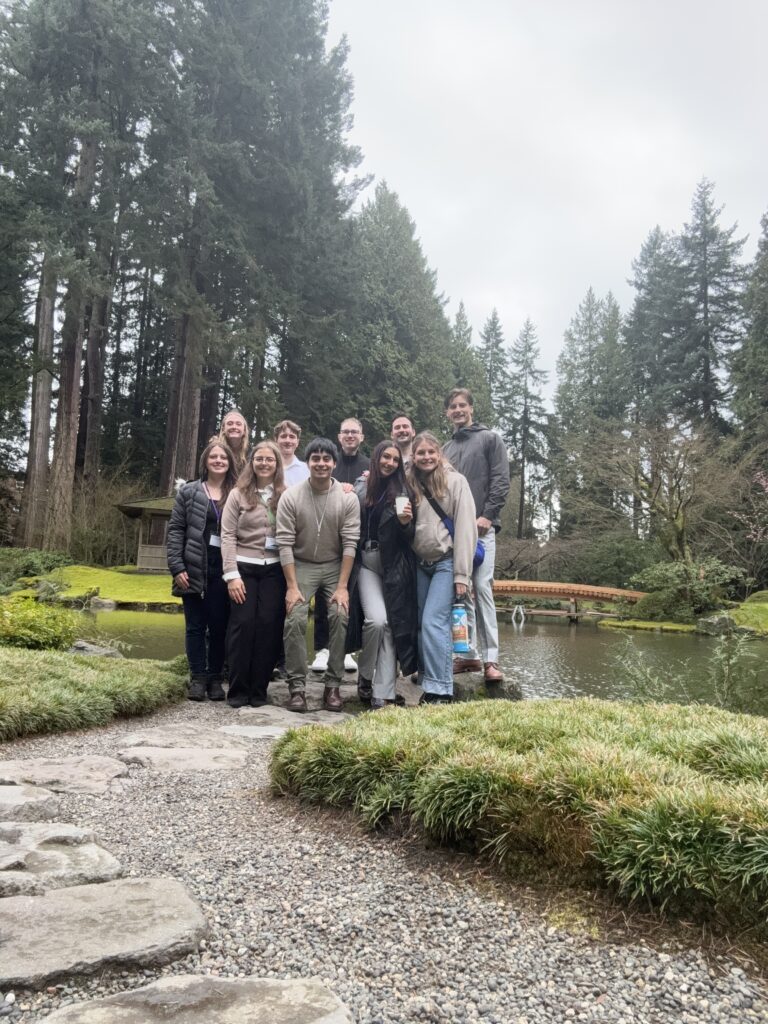
The time I have spent being a part of, and leading the TRU Geography club has been one of my most enjoyable and cherished University experiences. I joined the Geography club in 2024 and participated in group activities and attended conferences. In early 2025 I was offered a leadership role and graciously accepted it. I am currently the co-president of the TRU Geography Society (TRUGS). Together with Chris Pidlisecky we organized the attendance of TRU students at the Western Division of the Canadian Association of Geographers (WDCAG). We attended with 20+ students, giving these students the opportunity to present in an academic setting, and network with potential future employers. Inspiring and exposing young generations to conferences where academics network and discuss sustainability is extremely important to pursuing a future that is sustainable. The overall experience of being the co-president of TRUGS has aided in my leadership skill. It has allowed me to develop a skillset that involves collaborating with others to promote a club that gets people engaged with the environment. This engagement includes teaching students ways they can personally make a difference through living a more sustainable lifestyle. Specific examples and knowledge I have gained and shared include modifying overconsumption habits, effectively managing trash and recycling, modifying habits like long showers and high-meat product diets, and utilizing transit systems. Having the opportunity to lead others in this club has continued to solidify my values and attitude; that the environment is both sacred and fragile, and that every person can be part of the solution if they choose to educate themselves and live a more sustainable lifestyle.

Category E – Extra Curricular Knowledge Sharing – Poster Sharing at WDCAG

The photo on the left showcases the poster I presented at WDCAG in March 2024 – “The Survival of Rumbling Glacier, An Alpine Glacier In The Southern Coastal Mountains.” The photo on the right showcases the poster I presented at WDCAG, as well as at the TRU Undergraduate Conference, in March 2025 – “How Bend, Recreational Appeal is Driving Urban Expansion, and Resulting in a Less Sustainable Fringe Compared to Lethbridge, Albertas Rural Landscape.” The experience I had of presenting my poster in 2024 was extremely nerve wracking. It was my first time ever attending the conference and I felt a strong sensation of imposters syndrome, I was no established academic. Despite this, the experience was great, I got to meet a lot of people who were passionate about Geography and network with like-minded individuals. In 2025, when I found myself once again presenting a poster, this time about rural/urban sustainability, I felt confident in my research and my work. Having been at TRU for three years, and succeeding in a handful of sustainability related courses. I felt as through I had the qualifications and knowledge to inform and teach other about sustainability. I now know that I will always take the opportunity to share my work, and hopefully, inspire others to do the same, to feel passionate towards their research and the health of our environment.

Category F – Course Related Work – Wicked Problems Webpage

The webpage and presentation notes attached above showcase the final project that I created and presented for my Graduating-Seminar (GEOG 4280). This course related work allowed me to do an in depth analysis of the Great Pacific Garbage Patch (GPGP). My research identified the stakeholders that are involved in the GPGP accumulation, gaps that exist in mitigation measures, and levers of action or change that could be pursued in order to tackle the wicked problem that is the GPGP. This class, and the creation of my webpage, gave me the knowledge and understanding of just how complex environmental issues are. In addition it also taught me how to begin to tackle these complex issues without becoming overwhelmed. Almost, if not all, environmental issues are wicked problems, in order to create a sustainable society one must both understand the problem thoroughly as well as be capable of identifying areas where the problem can begin to be resolved. This project and class has given me these skills, taking my knowledge from that of an outsider who observes the problems, to a citizen who can begin to mitigate and tackle it.

Giveback Project

Published Paper

Reference (without DOI as publishing is still in progress):

Goodall, E. (in press). There is A Positive Correlation Between Climate Change Indicators and The Increasing Economic Cost of Extreme Weather Events in the United States, Perspectives on the Economics of Climate Change (special issue). Future Earth: A Student Journal on Sustainability and the Environment.

: Hello!

Attached above is a commentary that I wrote for an Economics of Climate Change class (ECON 3410) in the Fall semester of 2025. This commentary is set to be published in the Future Earth student journal in late March or early April of 2026. This commentary addresses Economic costs, climate change, climate change influenced disasters, and mitigation strategies. It also is an extremely important tool that provides insight into the correlation between rising temperatures and costly disasters, allowing one to evaluate the importance of sustainable development through reviewing the commentary. This commentary can be used to evaluate the costs of acting now, to avoid future costs that would come from inaction. I chose this topic because there are many ways to view the value of addressing climate change, and I believe that viewing the costs to society that stems from climate change, (monetary and well-being costs), is one way to solidify and add clarity to why action now is necessary for the well-being of both present and future generations.

Personally, creating and writing this assignment allowed me to develop my skills in researching and evaluating correlations between environmental causes and societal impacts. It helped solidify my attitude towards how important it is to value future generation and to combat climate change through efficient policies and sustainable development. Seeing the increased costs of more disastrous storms over the last 44 years reveals that spending money on adaptation and mitigation now, will aid in decreasing costs in the future due to large scale, climate change driven disasters.